dead land Mewat, waste land, dead land, empty land. Codified in the Ottoman Land Law of 1858, modified in the early 1920s as Britain re-structures the colonial governance of Palestine, and surviving today in the Occupied Territories through a series … Continue reading “a possible history of oblivion”
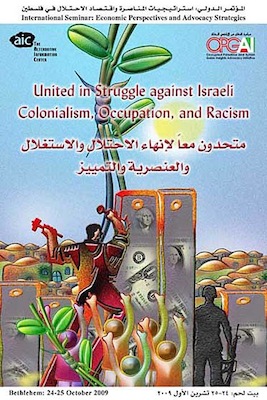
On July 1, 2011, the US Campaign for the Academic and Cultural Boycott of Israel (USACBI), sent a letter to several scholars at US universities, inviting them to join a historic delegation to Palestine. The letter began:
I arrived in Ramallah well prepared . . . or so I thought. I’d read Saree Makdisi’s chilling portrait of Palestinian life under occupation, historical accounts by Rashid Khalidi, Walid Khalidi, Ilan Pappe, Nur Mashala, and Gabriel Piterberg, powerful critiques of Israeli apartheid leveled by Ali Abunimah, Omar Baghouti, and Uri Davis, exposés penned by Israeli journalists Amira Hass and Gideon Levy, as well as pro-Zionist voices such as Amos Oz and A.B. Yehoshua. I had Edward Said by my side, and the Electronic Intifada and the Palestine Monitor in my web browser. Our small delegation, formed at the behest of the U.S. Academic and Cultural Boycott of Israel, consisted of some of the smartest people I know, their collective knowledge of the situation surpassed only by our hosts at Birzeit University in Ramallah. We were there on a fact-finding mission.
When reflecting on the week-long visit to Occupied Palestine and Israel – the delegation organized by the US Campaign for the Academic and Cultural Boycott of Israel (USACBI) – in some ways, the meeting that was the most provocative was with the Palestinian academics who hosted us at a public policy research center in Haifa called Mada al-Carmel: Arab Center for Applied Social Research. There we encountered critical and incisive perspectives on the academic boycott by Palestinian citizens of Israel that showed how the politics look different from their social location. Their penetrating critiques and our productive dialogue ultimately strengthened my understanding of the situation of fragmentation on the ground in Palestine, and of the need to grapple with this complexity to address what is, after all, one occupation.
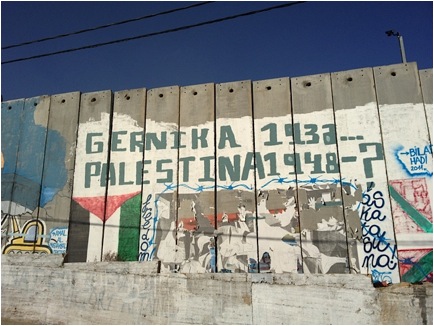
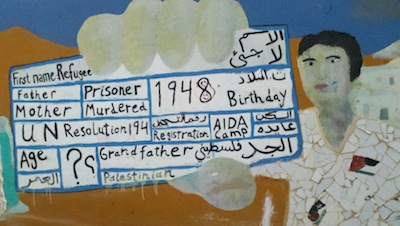
The eight meter high Apartheid Wall bordering the Aida Refugee Camp near Bethlehem features a tattered and faded replica of Pablo Picasso’s 1937 painting “Guernica.” The painting famously commemorates the bombing and massacre of nearly 1,600 civilians by Nazi German and Italian warplanes during the fight against fascism in the Spanish Civil War. Hand-painted barbed wire and a Palestinian flag frame the Wall’s reproduction. The caption above reads:
On July 1, 2011, the US Campaign for the Academic and Cultural Boycott of Israel (USACBI), sent a letter to several scholars at US universities, inviting them to join a historic delegation to Palestine. The letter began: We … Continue reading “529-2”
Submission Guidelines Website Submissions Journal Length & Format Special Issue FAQ Transmitting Including Art Index/Abstract Information Website Submissions Social Text welcomes proposals for website projects in the following categories: Features: short essays or reviews of about 1000 words Guest-edited dossiers … Continue reading “Submissions –”
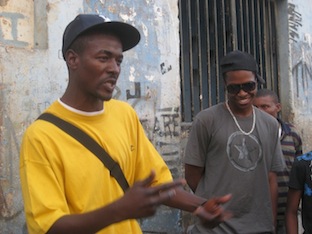
Kabu verdi / Nu bai / Gosi nu sta na Portugei / Nu bai / Es ta ben y sai / Chullage “Cape Verde / Let’s go / Now, we’re in Portugal / Let’s go / They [my people] … Continue reading “Bearing Witness and the Challenges of Community in Global Hip Hop”
In this interview, Christian Parenti and Mike Menser discuss issues raised by Parenti’s recently published book Tropic of Chaos: Climate Change and the New Geography of Violence. The Geography of Catastrophic Convergence MM: Kenya, Uganda and East Africa, Afghanistan, Pakistan, … Continue reading “Tropic of Chaos: Christian Parenti Interviewed”
Rob Nixon’s Slow Violence and the Environmentalism of the Poor was published this spring by Harvard University Press. Nixon’s work has been crucial to articulating the conjunction — as well as the fault lines — between postcolonial studies and ecocriticism. … Continue reading “Slow Violence and the Environmentalism of the Poor: An Interview with Rob Nixon”
The great colonial empires of the nineteenth and early twentieth centuries were, of course, brutal engines for the extraction of rents, crops, and minerals from tropical countrysides. Colonial cities and entrepôts, although often vast, sprawling, and dynamic, were demographically rather … Continue reading “The Urbanization of Empire: MEGACITIES AND THE LAWS OF CHAOS”
This essay is intended both as a specific study of interconnected moments in nineteenth-century British literature and as an opportunity to explore the cultural and political imagination of a people and its sites of production, reproduction, or transformation. Taking our … Continue reading “Edward Said, Reuben Sachs, and Victorian Zionism”
The Palestinian town of Ramallah, possibly on the lowest rung of urban hierarchies in the region, is a peripheral town trying to become a city on the fringes of the Arab world. Its nascent new middle class partakes enthusiastically in … Continue reading “Urban Modernity on the Periphery: A New Middle Class Reinvents the Palestinian City”

I saw Miral, the new film by Julian Schnabel last week. It was opening in New York and Los Angeles, to great controversy, as it was advertised as giving us a Palestinian point of view. My ears perked up when I … Continue reading “Painfully Beautiful”

