

We were both students at Harvard, in different capacities, the year that Larry Summers, the (our) then-university president, asserted that women might lack the innate aptitude for science. We became feminist friends through women’s, gender, and sexuality studies, a small intellectual oasis on Harvard’s campus where feminist thought, queer culture, and intellectual conversation created a refuge from the dominant norms of student life. We were both—even though we were almost a decade apart in age—learning that the life-giving feminist classrooms where we met were completely institutionally precarious. Meanwhile, the graduate program that we each attended was pockmarked a few years later by a scandal where John and Jean Comaroff conspired to conflate their advisory power with sexual power.
This is to say that when, many years later, Jefferey Epstein’s ecosystem of sex with women and girls implicated Harvard’s graduates, recipients of honorary degrees, faculty, and highest-rank official, the connection was more intuitive than surprising. Shock and awe accompanied the publicizing of Epstein’s predatory lifestyle to a wide(r) public; the university affiliations were imagined to be even more shocking because the men who were involved were upstanding nerds, giants in the academic world. But the collective horror that accompanied the news of the involvement—indeed, centrality—of university men as eager participants in Epstein’s world and of university fundraisers as eager launderers of Epstein’s ill-begotten money is a better indication of the efficacy of university self-mythos than it is a sign of something new.
Shameless antipathy toward women mixed with wealth and political power is the fundamental premise of life at elite private institutions, of which Harvard is the case study par excellence. While Harvard has not yet capitulated to the explicit destruction of the study of gender that inspired Joan Scott’s essay to which we respond, here, Scott’s conclusion that “the abolition of gender studies is a way of further guaranteeing impunity to the elite men whose contempt for and exploitation of women and girls apparently knew no bounds” certainly applies. Indeed, we began thinking about the connections between the gutting of gender studies and the granting of “impunity to … elite men” after the school’s newspaper, The Crimson, announced plummeting numbers of students in Harvard’s WGS program. If, as Scott observes, the Trump administration’s misapprehension of Title IX and its push to abolish the academic study of gender studies should be linked, then Harvard University should be understood as a key actor in this drama. Indeed, Harvard has found itself at the center of the twinned attacks on academic freedom of this moment. On the one hand, the panic about so-called “DEI” efforts made hypervisible in the end of Claudine Gay’s short-lived presidency, and on the other, the panic about “gender ideology,” a centrality that might have been predicted through its relationship to the field of women, gender, and sexuality studies.
Harvard’s history with WGS is one of long-term, intentional starvation. The university has denied the program necessary resources for decades, which makes the program’s vulnerability to contemporary circumstances all the more acute. In the decades that followed the emergence of women’s studies programs (as they were then called) across the country, many universities moved to departmentalize WGS and to allocate it tenure lines. While public universities took the lead in building the field of women’s studies, particularly at the level of graduate education, the wealthiest and most well-resourced institutions remained particularly apathetic (or worse, hostile) toward the project of WGS. Harvard’s hostility to WGS made it an outlier even among peer institutions, demonstrating that a lack of resources has not been the driving force preventing an investment in WGS.
Our field is under threat from state legislatures, university regents boards, and politicians who have sought to curtail or fully dismantle the academic study of gender and sexuality. (Indeed, the extent to which the field of WGS has been best supported in public universities may portend a particular kind of peril in this moment.) But at Harvard, the single biggest threat to the study of gender and sexuality has long come from the institution itself.
In lieu of financial and legal constraints, and in the face of evidence of profound donor power to shape the goings-on within the university, and, finally, given the robust and enthusiastic participation of Harvard’s men in Epstein’s circuit, we might simply call a spade a spade. There is a bright, clear line that connects the rhetoric of a university president who degrades the intelligence of his own women students with his participation in Epstein’s world; it is the same line that connects a university that funds its coffers from the donations of a sexual predator while keeping its gender and sexualities studies program on a shoestring budget. (Those lines are a warning, as well, that such a place also produced the men who cavorted with Epstein, for who among the Epstein class can be counted as Harvard alumni?) Suppressing the rigorous interdisciplinary study of gender and sexuality—which includes the interrogation of the cultural tolerance for violence against women—is precisely what fuels this kind of sexual predation and allows it to not only pass for normal male behavior but to be institutionally rewarded.
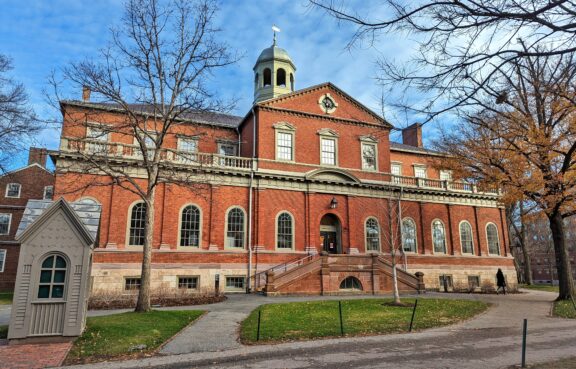
Cover image: Harvard Hall, Harvard University.

