

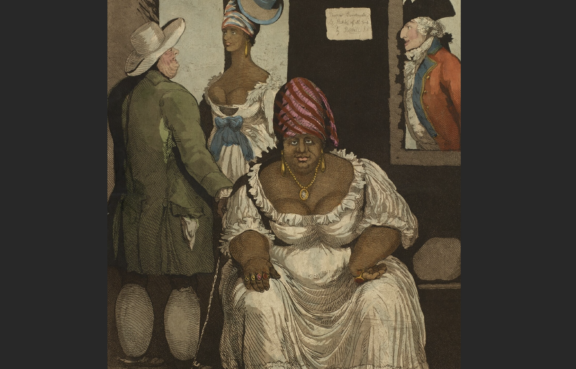
The Caribbean has a reputation. Slavery haunts the Jeffrey Epstein saga. The British planter Thomas Thistlewood wrote in his diaries of his time as an overseer and owner of slaves in Jamaica details of the many slave women he sexually abused. He often commented that he paid them. But he often also beat them. He kept details of their menstrual cycles. He detailed his and their venereal disease and treatments. Thistlewood’s diaries are a scatological account of sex, violence, and entitlement that sets a symbolic and actual foundation for white male engagements with the Caribbean region. Some historians have been ambivalent or made claims that Thistlewood’s sexual escapades should be read with ambivalence giving the slave women more sexual agency. Caribbean studies as a field of studies might orient us to how we might think of the region in this ongoing saga as more than a geographical place.
The Caribbean has long been a place of spoils and since Christopher Columbus’s “discovery” of the region the islands of the Caribbean have made and unmade people. And in that making and the unmaking, an idea of the Caribbean in a post-slavery world has emerged that makes it a place of idle leisure, commerce, self-making, and self-discovery against the backdrop of its beautiful, lush landscapes, its burning sun in blue skies, and its white sandy beaches, as any seductive tourist brochure would scream at you. It is not surprising to anyone familiar with the region that the Caribbean would play a central role in the still unfolding drama of the notorious sexual offender Jeffrey Epstein.
Epstein, now considered the most notorious mass sexual offender of the late twentieth century and into the twenty-first, owned two private Caribbean islands—Little St. James and Great St. James. The Epstein files, especially Epstein’s emails, function similarly, but do not map on directly, to planter accounts of their activities in the colonies. The files are not exactly like Thistlewood’s diaries, but we can read them in that light, nonetheless. Post-Columbus, the Caribbean region became an arena of commerce. And that commerce was not only the trade in extracted commodities, but importantly the trade in flesh—first Indigenous enslavement, then later African enslavement, and later still, yet differently, Indian indentureship. And always wrapped up in that commerce has been a story of sex and its exploitation. From where I stand in the Americas, it would indeed be surprising if the Caribbean did not play a role in the central drama of a global sexual trafficking organization.
Epstein’s behavior and practices do not break with this account of the Caribbean as a zone of commerce of all kinds. Indeed, the Epstein story keeps the tradition of the region as a central node of commerce, especially of the sexual trade, intact. The islands that constitute the United States Virgin Islands bear all the hallmarks of the European and Euro-American colonialist expansion project in the region from 1492 to the present. The idea of the private island should give us all pause, but I will suspend my ideas on property and the landscape for the moment. The purchase of the Virgin Islands from Denmark in 1917 (think of Greenland today) for $25,000,000 in gold coin was lauded as a measure to protect the newly built Panama Canal from entering the hands of Germany during World War I. The idea of strategic military significance remains a central element of post-Columbus commerce in the Caribbean region and beyond today. The citizens of the Virgin Islands are US citizens and subject to all its laws. But the US Virgin Islands cannot be divorced from the larger tropes that frame the history of the Caribbean region too as a place to idle and play where you can lose yourself.
It appears, from much available evidence, that the tropics does things to white men. The long-running trope, backed up by the evidence and accounts of both slaves and masters, of white men losing their sense of morality in the tropics is a trope worth tarrying with. From excessive alcohol use to licentious sex, brutal forms of violence, and debauchery of all kinds, also including mental illness, it appears that the tropics makes white men lose control. The Epstein islands were the place where powerful white men could go and lose themselves, abusing young white women and reportedly even younger white girls. The traffic in women and girls to and across the region has a long history rooted in white men’s libidinal desire to rule the world. A significant element of the exercise of the rule of the world is control over women’s bodies.
The juxtaposition of late twentieth century and early twenty-first century white women being trafficked to the Caribbean for sexual purposes meets the Black slave woman at a vastly different juncture. In Mary Prince’s The History of Mary Prince, A West Indian Slave, Related by Herself, Prince hints at sexual abuse by her master. Prince was owned, rented out, shipped to other islands, and she eventually sought and acquired her freedom in England. Nonetheless, before taking her freedom, Prince experienced sexualized abuse as a slave woman. For example, she writes: “Mr. D – has often stripped me naked, hung me up by the wrists, and beat me with cow-skin, with his own hand, till my body was raw with gashes” (62-63). Prince further details: “He had an ugly fashion of stripping himself quite naked and ordering me then to wash him in a tub of water. This was worse to me than all the licks. Sometimes when he called me to wash him I would not come, my eyes were so full of shame. He would then come to beat me” (67-68). What Christina Sharpe has termed “monstrous intimacies” is clearly present in the “sadomasochism of the everyday black life” (23) of the slave. That the Caribbean, post-slavery, re-emerges as a place of sexually driven dominated pleasure for white men should not be lost on anyone who takes seriously the complicated dynamics of cross-racial sex during and after slavery. A certain kind of white (male) racial consciousness is revealed.
It has been reported that Epstein rejected Black girls for his abusive “massages” and other exploitative sexual fetishes. Epstein was unlike Thistlewood concerning his racial choice of women and girls, but both men meet at the junction of sadism. Thistlewood chronicled in great detail in his diaries his sadistic behavior on the plantation including his sexual appetites and scatological punishments. Thistlewood’s diaries stand as an urtext to the wishfully missing black book of the Epstein saga. For both Thistlewood and Epstein the Caribbean was a place where they could demonstrate and exercise their proximity to power and wealth. Commerce remains at the center of the story wherever the Caribbean is concerned.
Reports suggest that the escapades on Epstein’s Caribbean island provided Epstein the opportunity to collect valuable information about the male frolickers that he could potentially use to blackmail them. Again, commerce raises its ugly head. The Epstein estate has had to pay restitution in a settlement with the government of the US Virgin Islands for sex trafficking, child exploitation, tax fraud, and environmental remediation. This detail stood out for me in the settlement: “The Estate also agreed to pay $450,000 to remediate environmental damage around Great St. James, another Epstein-owned island, where the government found that Epstein razed the remains of centuries’-old historical structures of enslaved workers to make room for his development.” Slavery haunts the entire enterprise.
Despite Epstein’s refusal of Black girls–a lucky refusal for them, we must add–Black girls and women remain one of the reasons that the Caribbean is a sex tourism destination. And concurrently the Caribbean is also a region where the logic and ideas of sex trafficking also meet their complicated implementation. The role of white womanhood in this story of the Caribbean cannot be sidestepped. Ghislaine Maxwell’s role as both exemplary of genteel white womanhood and as facilitator and recruiter of young white women echoes the plantation. Indeed, in the contemporary Caribbean sexual and erotic economy, where white women are also consumers of sex in the region, this cannot be understated. The disjuncture between economies in the North and the post-slavery/post-independence poverty of the region places white women from the North in dominant positions of purchasing sex in the region. Of course, a Black woman does make an appearance in the Epstein files: the super model Naomi Campbell. Campbell has denied any wrongdoing. Campbell’s “cameo” in the files is a symbolic sign of the long shadow of slavery’s monstrous intimacy of post-slavery sexual relations—their complications and the communities they make appear.
The above tensions reveal some of the reasons that fields such as women and gender studies continue to view Black women scholars as troublemakers. The scholar Kamala Kempadoo, in her Sexing the Caribbean: Gender, Race, and Sexual Labor, has offered a more nuanced understanding of sex trafficking laws when sex workers are involved. In a post-independence Caribbean where poverty and sex work mingle, the question of subjectivity, choice, and sex work requires careful untangling. Kempadoo writes: “my own and others’ research during the 1990s began to shift this approach and pay attention to trafficking as a violation of sex workers’ civil, labor, and human rights” rather than merely illegal subjection and a taking away of women’s agency to make decisions about their lives as sex workers. Kempadoo offers a nuanced understanding of the relationship between the push and pull of migration for sex work and trafficking. She points out that some iterations of sex trafficking laws seek to make sex work illegal rather than protect women and that many sex workers are more concerned with “the working conditions in the brothel that they describe as intolerable and coercive, not the work itself.” The women involved in the Epstein scandal are not understood to be either of Caribbean origin or sex workers, but their experience provides a caution for how we might understand what is at stake in terms of sex, money, gender, youth, and the region as a backdrop for white male authorized hedonism.
But another account of the region is also possible. An account that is politically resistive, psycho-socially recuperative, and oriented to a liberatory future. In this case I turn to the Black feminist Audre Lorde. Lorde died in 1992 from cancer on St. Croix in the US Virgin Islands. There, for a moment, in the Caribbean, Lorde lived a recuperative life, and St. Croix was the site of Lorde’s final earthly experiences. Lorde’s critical recuperative experience of the Caribbean—in relation to the Caribbean’s colonial subjection and its African ancestral curative potential—both rebukes Epstein’s frolic and offers us a different possibility of the region too.
Cover image: Thomas Rowlandson after E.D., Rachael Pringle Polgreen of Barbados, 1796.
