

In 2007, University of California, Los Angeles adjunct professor emeritus of neurology Mark Tramo, then at Harvard University, sent an assistant of Jeffrey Epstein a message of support after having “read the newspapers,” writing, “please remind him that boys from The Bronx (even if they end up at Harvard) have long memories, know all about cops, and stay true to their friends through thick and thin (no less peccadilloes).” Tramo describes what had landed Epstein in the news in the first place, that is, charges of solicitation of prostitution and procurement of minors to engage in prostitution, as “peccadilloes,” a term that means a minor infraction of a forgivable kind. This message thus literally describes the Epstein class through an explicit invocation of the loyalties entitled to those in the old boys’ club.
Epstein was convicted of those charges in 2008. Despite this paper trail, in 2026 Tramo claimed that he did not know about Epstein’s crimes against minors prior to his arrest in 2019 for sex trafficking. Long after Epstein’s conviction and after Tramo had left Harvard to take up his role as faculty at UCLA, the “boys from The Bronx” kept up a correspondence. Tramo sent Epstein resumes of students and thanked him for making his work, including his course Music, Mind, and Brain, at UCLA, possible. Tramo’s Institute of Music and Brain Science also accepted a $100,000 donation from an Epstein charity in 2017. UCLA’s official reaction to these revelations about one of its faculty has been silence and stonewalling. UCLA Media Relations spokespeople have refused to comment about the matter when contacted by journalists. In the wake of this scandal, Tramo cancelled a planned class and then promptly retired, complaining bitterly on his way out about the “McCarthyism, hysteria, and prejudice” that he ostensibly suffered.
In email correspondence with the Daily Bruin, Tramo justified his continued relationship with Epstein by asserting that it was for philanthropic purposes, blithely assuming that this rationale was exculpatory. His explanation that he was just “trying to advance [his] work, for the betterment of society” is particularly obtuse given that he was attempting to legitimize his association with a convicted child trafficker, but ultimately not inconsistent with the rationale for all university donor cultivation efforts. The issue at hand here is not simply whether or not UCLA took donations from Epstein in particular. In 2025, colleges raised $78 billion from fundraising, with the majority of that funding going to elite private schools and large public research universities. 89% of those funds came from just 2% of donors. While philanthropic giving, which includes both individual donors and private foundations, has historically accounted for 10% of the core operating budget of higher education institutions, university administrators are deeply anxious about bringing in new donors and subservient to the whims of existing ones, resulting in pernicious examples of donor influence over academic decisions. As state and federal funding shrinks, administrators at private and public universities alike look upon the Epstein class as the only theoretically unlimited source of income. UCLA or any other university theoretically could be principled enough to only accept donations from stellar, saintly members of the wealthy class, but Dolly Parton’s fortune is not unlimited, and more importantly, such policies would not solve the larger problem.
Tramo’s assumption that his research intrinsically was for the “betterment of society” is a part of a general understanding of knowledge production in the abstract—which is to say, a notion that knowledge can be divorced from the conditions which produce it as well as its effects in the world—as intrinsically good and societally beneficial. In fact, a significant body of feminist scholarship has long critiqued this notion. Abstract orientations toward knowledge presume that ideas exist free from the materiality of the bodies and subjectivities that produce them, a Cartesian framework that universalizes Enlightenment rationality and elides the gendered, (de)racinated, and colonial conditions of knowledge production. In the US academy, feminist scholarship critiquing such presumptions emerged in the wake of the student social movements of the 1960s that established ethnic studies. As documented by Mike Murase, one of the core demands of these movements was for an education relevant to the students’ contexts and contemporary conditions. These movements were based on a radically different understanding of knowledge production that critiqued the colonial and civilizational underpinnings of the university as the institutionalized disavowal of the violation, violence, and extraction at the heart of abstract knowledge.
Despite such critiques, the presumption of knowledge in the abstract as a greater good remains a legitimating force in the political economy of the modern university. While critiques of abstract knowledge as privileging Western modes of learning and thinking and thus leading to the exclusion and expulsion of racialized and gendered subjects from the university are by now familiar, we can now see another avenue of weaponization in its mobilization as a rationale for privatization. As Davarian Baldwin has observed, “the presumption that anything a university does is inherently for the public good—all this has become a powerful mechanism for sheltering the private interests that are driving the new knowledge economy.” This presumption underlies the tax status of universities as non-profits which means that both corporations and individuals are provided tax breaks for their donations, thus diverting those funds from the tax base. Summarizing Baldwin’s argument, Sam Klug notes, “The ‘public good’ ideology of universities … actually reduces public contributions to public goods in the cities around them.”
Because we are all implicated in this political economy, it is imperative to approach knowledge production projects as not a good in and of itself, but with a sense of the power relations such projects seek to intervene in and a sense of responsibility to communities bearing the brunt of those relations. One such project is Survivors + Allies (S+A), a student organization that formed in 2020 to advocate for survivors of sexual violence. Initially established at UCLA and subsequently expanding across the UC system, S+A at first focused on improving Title IX office resources, including requesting that the system-wide Title IX office conduct a UC-wide survey on survivors’ experiences with Title IX processes. S+A members who were at this meeting recounted to the author that the UC Title IX administrator’s dismaying response was that she would not launch such a study because the results would be too demoralizing for her staff.
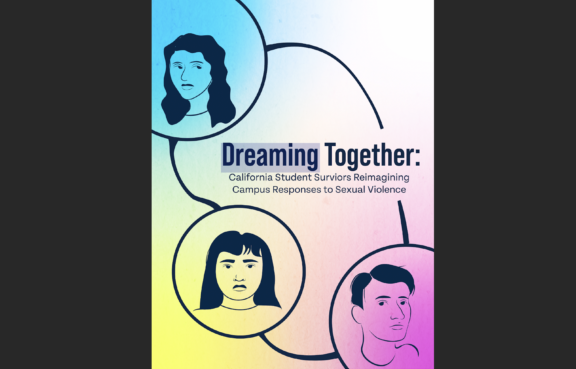
While this tacit admission is itself proof of the inadequacy of Title IX processes, S+A decided that if the UC refused to conduct such a study, they would do it themselves. This group of graduate and undergraduate students (and eventually, as these students graduated, alumni), led by then-PhD student in the Department of Social Welfare Sara Wilf, collectively created a survey, got IRB approval, and collected over twelve hundred responses across all nine UC campuses. Central to the group’s methodology is a survivor-centered process that prioritizes the welfare of survey participants and researchers: any data that might retraumatize anyone in the process of collection is not data that they need or want. S+A researchers have produced a full-length report, eight research briefs, and two scholarly articles based on their work. The report laid out how sexual violence response in the UCs is inadequate, underfunded, and focused on investigation and punishment rather than on support for survivors; the report also showed that international students, students of color, and LGBTQ+ students are particularly marginalized and further violated by these processes. An astounding 100% of Black and Latine respondents reported being disrespected by Title IX staff, for example. The first quantitative study of sexual violence in higher education in California, this report was cited in every bill in a package of a dozen introduced by the California legislature’s Committee on Higher Education in 2024. Eleven of those bills passed. S+A subsequently conducted a second, even more ambitious study in 2025 based on over sixteen hundred survey responses and twenty in-depth qualitative interviews from UCs, Cal States, and community colleges. S+A members have since successfully sponsored their own bill, AB 2212, the HEAR Survivors Act, which became law in September of 2026.
This is not to say that university development officers might not ever use the research generated by S+A to court donors. It would be a hard sell in some ways, as the work of S+A paints the university as a place rife with sexual violence at all levels, violence that the university not only does not address but that it enables and proliferates. Even if one has never met a university development officer, it is not hard to imagine how centrally their job is based on boosterism, an orientation that does not lend itself easily to admitting to, much less highlighting, university-based violence. That being said, if there were a donor who was interested in donating money to address this issue, I have no doubt that development officers would pivot to S+A in a heartbeat. And S+A and the units that support it would likely and rightly accept that money (depending on who it was from, obviously), using the same rationale that Tramo used about accepting money from Epstein, that is, that this donation would help get good work done. This is why we need to have a structural critique of the university and its dependence on donors. As I mentioned previously, we are all implicated in this political economy.
The work of S+A demonstrates that the Epstein class is not simply a group of nefarious elites, though they are certainly that. In this context, I point to S+A not to claim that it is somehow outside of the economic relations of the university, but to emphasize that within these relations, we can still amplify and support research projects that attend to urgent and concrete needs, particularly those animated by researchers and participants who are prioritizing those most affected by such conditions. For the Epstein class and those in the university who gleefully pander to them for money and influence, sexual violence and exploitation are collateral damage and those who suffer are negligible non-entities. Against this calculus, projects like Survivors + Allies show us a different way.
Cover image: Report cover for S+A’s “Dreaming Together.”
